
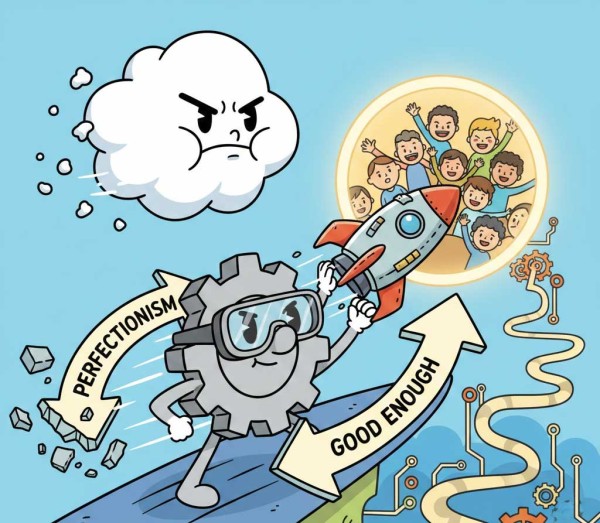
Getting Your Product to Market with "Good Enough"
What you'll learn
 The Trap of PerfectionismThe "Good Enough" MindsetBenefits of Early LaunchStrategies for Iteration
Embracing "Good Enough": Overcoming Perfectionism to Get Your Product to Market
As a small business owner, the journey from idea to market can feel like an endless uphill battle. You pour your heart and soul into creating something remarkable, striving for excellence in every detail. While this dedication is commendable, it often leads to a subtle yet powerful foe: perfectionism. This relentless pursuit of an ideal, often unattainable, can trap you in a cycle of endless refinement, delaying your product's launch and preventing your innovative ideas from ever reaching the customers who need them. This article explores how embracing a "good enough" mindset can be the strategic pivot you need to break free from perfectionism, accelerate your market entry, and foster continuous growth for your venture.
The Invisible Barrier: Understanding Perfectionism
As an owner of a small business or a side hustle, you’re likely driven by a passion to create something exceptional. This drive, while admirable, can often morph into a debilitating obsession with perfection. You might find yourself endlessly tweaking a website design, adding one more feature to your product, or polishing copy until it shines beyond recognition. This isn't just about high standards; it's about a fear of imperfection, a subconscious belief that anything less than flawless will lead to failure or judgment.
Perfectionism manifests in various ways. It can be the constant urge to restart a project because the initial approach wasn't "right." It might be the inability to delegate tasks because no one else can do it "perfectly." It often leads to analysis paralysis, where the sheer volume of details to perfect prevents any meaningful action. The consequence? Missed deadlines, stalled launches, and ultimately, products that never see the light of day, or do so only after their opportune moment has passed.
Embracing "Good Enough": A Strategic Shift
The concept of "good enough" isn't about mediocrity or lowering your standards for quality. Instead, it's a strategic mindset that prioritizes functionality, core value delivery, and timely market entry over an unattainable ideal of flawlessness. It means understanding that your initial offering doesn't have to be the final, ultimate version of your vision. It simply needs to be solid enough to solve a problem for your target audience, dependable enough to be used, and polished enough to represent your brand professionally.
Think of it as the minimum viable product (MVP) approach but applied to your entire business philosophy. What is the absolute core offering that provides value? What can you launch now that addresses a real need, even if it lacks some of the bells and whistles you envision for later versions? Shifting to a "good enough" mindset requires courage to release something that isn't "perfect" in your eyes, trusting that real-world feedback is more valuable than theoretical perfection.
The Power of Prototyping and MVPs
A Minimum Viable Product (MVP) is a product with just enough features to satisfy early customers and provide feedback for future product development. It’s the embodiment of the "good enough" philosophy. Instead of spending months or years building every conceivable feature, an MVP allows you to validate your core idea quickly and efficiently. This approach is particularly powerful for small businesses and side hustles because it minimizes risk and conserves precious resources.
Prototyping, whether it's a simple sketch, a wireframe, or a basic functional model, is another key strategy. It allows you to test concepts and gather initial reactions without investing heavily in full development. These early versions aren't meant to be perfect; they're meant to be learning tools. The goal is to get something tangible into the hands of potential users as quickly as possible to gather insights and refine your direction.
Why Launch Early? The Benefits Outweigh the Risks
Delaying your product launch in pursuit of perfection carries significant opportunity costs. Launching earlier, even with a "good enough" product, unlocks a cascade of benefits crucial for small businesses and side hustles:
- Faster Feedback Loops: Real users interacting with your product provide invaluable insights that no amount of internal testing can replicate. This feedback is essential for understanding what works, what doesn't, and what features truly matter.
- Market Validation: An early launch allows you to test your assumptions about market demand and product-market fit. Is there a genuine need for what you're offering? Are people willing to pay for it?
- Accelerated Revenue Generation: Getting your product to market sooner means you can start generating sales and cash flow earlier. This financial momentum is vital for reinvesting in your business and funding future improvements.
- Learning and Adaptation: The market is constantly evolving. An early launch positions you to learn faster, adapt to changing customer needs, and pivot your strategy if necessary, staying agile in a competitive landscape.
- Building Brand Presence: Even a "good enough" product begins to establish your presence and build an audience. Early adopters can become loyal customers and advocates, laying the groundwork for stronger brand recognition.
Strategies for a "Good Enough" Launch
Implementing a "good enough" launch requires discipline and a clear strategy. Here are practical steps to guide you:
- Define Core Features: Clearly identify the absolute minimum set of features that deliver your product's primary value proposition. Strip away anything that isn't essential for the initial launch.
- Set Realistic Deadlines: Establish aggressive but achievable deadlines for your launch. Use these deadlines as non-negotiable targets to prevent scope creep and endless tinkering.
- Prioritize Functionality Over Polish: While aesthetics are important, ensuring your product works flawlessly for its core purpose should take precedence over minor design tweaks or elaborate animations in the early stages.
- Communicate Clearly with Customers: Be transparent. Let early users know that they are part of a journey and their feedback is crucial for evolving the product. This honesty builds trust and a sense of community.
- Prepare for Iteration: Don't view the launch as the finish line. Plan for subsequent updates and feature additions based on the feedback you receive. Set up systems to collect and analyze user input effectively.
Iterate, Don't Hesitate
The "good enough" launch is not the end goal; it's the starting line for continuous improvement. Once your product is in the hands of users, the real learning begins. Collect feedback through surveys, reviews, direct conversations, and analytics. Use this data to inform your next steps. What features should be added? What areas need refinement? What bugs need fixing?
This iterative process allows your product to evolve organically, guided by actual user needs and market demands, rather than your initial, potentially flawed, assumptions of perfection. Each iteration brings you closer to a truly great product, built on a foundation of real-world value.
Conclusion
For small business owners and side hustlers, overcoming the allure of perfectionism is not just a personal challenge but a strategic imperative. Embracing the "good enough" mindset allows you to accelerate your product's journey to market, gather invaluable real-world feedback, and begin generating revenue sooner. By focusing on core value, launching strategically, and committing to continuous iteration, you can transform the dream of a perfect product into the reality of a growing, successful business that consistently meets customer needs. Remember, a launched, imperfect product that is solving a problem is infinitely more valuable than a perfect product that never sees the light of day.
Comprehension questions
 How does perfectionism specifically hinder small business owners and side hustlers from launching their products?What is the core difference between pursuing "good enough" and simply aiming for mediocrity in product development?What are three key benefits a small business can gain by launching a "good enough" product early rather than delaying for perfection?According to the article, what is the role of an MVP (Minimum Viable Product) in overcoming perfectionism and achieving an early launch?