
Making Your Side Business Stand Out
What you'll learn
 Niche IdentificationLeveraging Unique StrengthsCrafting a Value PropositionSustaining Market Relevance
Many small businesses and side hustles emerge from passion and a desire for independence. However, the digital age has lowered barriers to entry, leading to incredibly crowded markets. Simply offering a good product or service is often not enough to capture attention or sustain growth. To thrive, you need to identify and articulate what makes your offering distinctly different and superior. This isn't just about being good; it's about being memorable and irreplaceable in the eyes of your ideal customer. Discovering your competitive edge is the bedrock upon which lasting success is built, allowing you to not just compete, but truly dominate your chosen segment.
Defining Your Niche and Audience
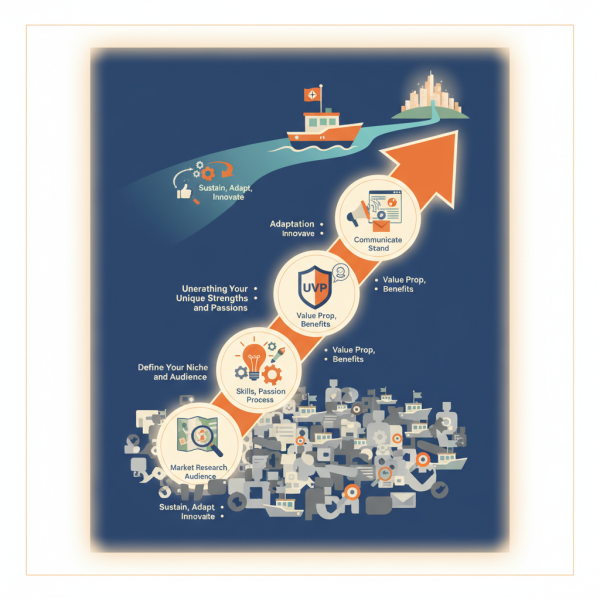
Before you can stand out, you need to know who you're trying to stand out to. A common mistake is trying to appeal to everyone. This dilutes your message and makes it harder to identify what truly makes you unique. Instead, hone in on a specific niche. Who is your ideal customer? What are their specific needs, pain points, and desires that aren't being fully met by current solutions? The narrower your focus, the clearer your path to differentiation becomes.
- Market Research: Dive deep into understanding your potential customers. What demographics define them? What are their psychographics? Where do they spend their time online and offline?
- Competitor Analysis: Look at who else serves this niche. What do they do well? Where are their weaknesses? Are there unmet needs or underserved segments that you could address?
- Problem Identification: What specific problem does your business solve for this defined audience? The more acute the problem, the more valuable your unique solution will be.
Unearthing Your Unique Strengths and Passions
Your competitive edge often lies at the intersection of what you're good at, what you love to do, and what the market needs. Reflect on your personal skills, experiences, and the unique way you approach problems. Don't underestimate the power of your own personality or the specific expertise you've accumulated, even if it feels ordinary to you. This introspection is crucial for authentic differentiation.
- Personal Skills and Expertise: What specialized knowledge or abilities do you possess? Are you exceptionally fast, detail-oriented, creative, or great at building relationships?
- Unique Process or Methodology: Do you have a distinct way of doing things that leads to better results, faster delivery, or a superior customer experience?
- Specific Experience: Has your background given you insights or connections that others lack? Perhaps you've worked in a particular industry or faced a challenge that makes you uniquely qualified.
- Passion and Purpose: When you genuinely care about what you do, it shines through. This passion can translate into superior customer service, innovative solutions, and a memorable brand story.
Crafting a Compelling Value Proposition
Once you understand your niche and your unique strengths, you can articulate your Unique Value Proposition (UVP). This is a clear, concise statement that explains why a customer should choose you over anyone else. It's not just a list of features; it's about the tangible benefits and emotional resonance your business provides. Your UVP should address the customer's pain points directly and highlight how your uniqueness solves them more effectively or enjoyably.
Consider answering these questions: What specific problem do you solve? How do you solve it differently or better than competitors? What unique benefit does the customer receive? A strong UVP becomes the core of your messaging and guides all your marketing efforts. It's the promise you make to your customers.
Communicating Your Edge Effectively
Having a competitive edge is only valuable if your target audience knows about it. Effective communication is paramount. Every touchpoint with a potential customer – from your website and social media profiles to your emails and personal interactions – should consistently convey your unique value. Use clear, benefit-driven language that resonates with your specific niche.
Tell your story. Why did you start this business? What problems were you passionate about solving? How does your unique approach translate into a better outcome for them? Visual branding, tone of voice, and even your customer service approach can all reinforce your distinct identity. Don't just list what you do; explain why it matters and how it makes a difference.
Sustaining Your Uniqueness and Adapting
The market is not static. Competitors will emerge, customer needs will evolve, and new technologies will change the landscape. Your competitive edge needs continuous refinement and adaptation. Regularly reassess your niche, listen to customer feedback, and keep an eye on industry trends. What might be unique today could become standard practice tomorrow.
Innovation isn't a one-time event; it's an ongoing process. Stay curious, be willing to experiment, and don't be afraid to pivot if necessary. By constantly seeking ways to enhance your offering and deepen your connection with your audience, you can ensure your side business remains not just competitive, but truly indispensable.
Conclusion
In the bustling marketplace, merely existing isn't enough; you must distinguish yourself. Finding your competitive edge involves a deep dive into your market, an honest assessment of your unique strengths, and the careful articulation of a compelling value proposition. By defining your niche, leveraging your individuality, and communicating your distinct advantage clearly, your side business can cut through the noise. This commitment to uniqueness, coupled with continuous adaptation, is not just a strategy for survival, but a robust blueprint for achieving significant, sustainable growth and making a lasting impact.
Comprehension questions
 Why is defining a specific niche important for a side business in a crowded market?What three areas should small business owners reflect on to unearth their unique strengths?How does a strong Unique Value Proposition (UVP) benefit a side business?What ongoing activities are crucial for sustaining a competitive edge in an evolving market?