
How Specializing Leads to Faster Growth
What you'll learn
 Niche SpecializationAccelerated Business GrowthTargeted Marketing StrategiesCompetitive Advantage
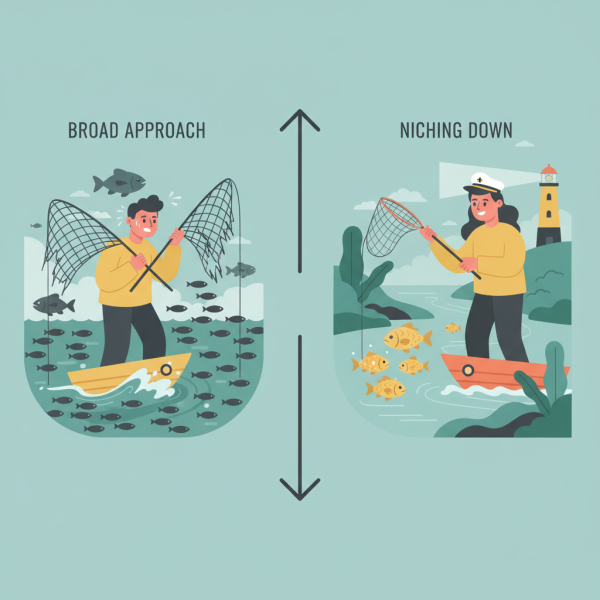
In the vast landscape of entrepreneurship, many small business owners and side hustlers believe that casting a wide net will capture the most customers. The logic seems sound: offer something for everyone, and you'll surely get a piece of the market. However, this broad approach often leads to diluted efforts, fierce competition, and slower growth. The counter-intuitive truth is that by "niching down" – focusing intensely on a specific, smaller segment of the market – you can actually achieve faster, more sustainable growth and establish a much stronger foothold. Specializing allows you to become the undeniable expert, catering precisely to the unique needs of a select group, rather than being just another option in a crowded field.
The Illusion of Broad Appeal
When you try to appeal to everyone, you often end up appealing to no one particularly well. Imagine a general practitioner versus a specialist surgeon. While the GP serves a broad population, the surgeon, focused on a specific complex area, commands higher fees, faces less direct competition for their specialized services, and is sought out for their deep expertise. Similarly, a small business that tries to solve all problems for all people will struggle to create compelling marketing messages, develop truly tailored products or services, and build a distinct brand identity. Your resources, time, and budget are finite; spreading them too thinly diminishes their impact.
The generalist approach forces you into direct competition with larger, more established companies that have deeper pockets and broader reach. It becomes a race to the bottom on price, where differentiation is minimal and customer loyalty is fleeting. By attempting to serve a generic market, you lose the opportunity to truly understand and connect with a specific client base, which is where true value and strong relationships are built.
Defining Your Unique Niche
The first step to niching down is to identify who you can best serve and what specific problem you are uniquely positioned to solve. This isn't about excluding potential customers but rather about strategically choosing your ideal customers. Consider what you are passionate about, what specific skills or experiences you possess, and where there's an unmet need in the market. A well-defined niche should be:
- Specific: Clearly identifiable with unique characteristics.
- Passionate: An area where you have genuine interest or expertise.
- Profitable: Contains enough potential customers willing to pay for your solution.
- Accessible: You can reach these customers effectively through marketing.
Think beyond demographics. A niche isn't just "women aged 30-45." It could be "busy mothers of toddlers seeking organic meal prep solutions" or "independent graphic designers looking for advanced portfolio review and business coaching." The more granular you get, the clearer your path becomes. This process involves deep market research, listening to your audience, and understanding their pain points and aspirations.
The Powerful Advantages of Specialization
Once you commit to a niche, a powerful transformation begins. The benefits are numerous and directly contribute to faster growth and greater profitability:
- Deeper Expertise and Authority: You become the go-to expert in your chosen area. This credibility attracts clients who specifically need your specialized knowledge, allowing you to charge premium prices.
- Reduced Competition: While the overall market might be crowded, your specific niche is likely far less so. You're not competing with everyone, but with a handful of others, or perhaps even nobody, offering exactly what you do.
- Clearer Marketing and Messaging: Knowing your ideal client intimately means you can craft marketing messages that resonate deeply and speak directly to their specific challenges and desires. This leads to higher conversion rates and more efficient marketing spend.
- Higher Perceived Value and Pricing Power: When you solve a very specific problem for a specific group, your services are seen as highly valuable and less commoditized. Clients are willing to pay more for a precise solution that addresses their unique needs.
- Increased Efficiency and Innovation: Focusing your resources on a narrow market allows you to refine your products or services quickly, innovate faster based on direct feedback, and streamline your operations. You avoid the distraction of trying to be everything to everyone.
- Stronger Customer Loyalty and Referrals: When you consistently deliver exceptional, tailored solutions, you build strong relationships and trust. Satisfied niche clients become your biggest advocates, leading to organic growth through word-of-mouth referrals.
Practical Steps to Niche Down Effectively
The journey to specialization requires deliberate action. Start by honestly assessing your current offerings and client base. Who are your favorite clients? What specific problems do you truly excel at solving? What unique skills do you bring to the table?
Next, conduct thorough market research. Use online tools, surveys, and direct interviews to understand the needs, preferences, and challenges of your potential niche audience. Look for underserved segments or unique angles within larger markets. Don't be afraid to experiment with your messaging and offerings to see what resonates most effectively.
Overcoming the Fear of Missing Out (FOMO)
Many entrepreneurs hesitate to niche down due to the fear of "leaving money on the table" or missing out on potential customers. This FOMO is understandable but often unfounded. The reality is that by focusing, you don't lose customers; you gain the right customers – those who truly value your specialized offering and are willing to pay for it. The customers you "miss" were likely not your ideal clients anyway, requiring more effort for less return.
Embrace the idea that less is more. A smaller, highly engaged, and loyal customer base is far more valuable and profitable than a large, disengaged, and price-sensitive general audience. Niching down is not about limiting your potential; it's about amplifying your impact and maximizing your growth within a defined, manageable, and highly rewarding market segment.
Summary
In conclusion, for small business owners and side hustlers, the path to faster growth and greater success often lies not in broad appeal, but in strategic specialization. By defining a precise niche, you unlock a wealth of advantages including deeper expertise, reduced competition, enhanced pricing power, clearer marketing, and stronger client loyalty. While the fear of missing out might initially deter some, embracing focus allows you to become the indispensable solution for a select group, ultimately leading to more efficient operations, increased profitability, and a stronger, more sustainable business model.
Comprehension questions
 What is the primary counter-intuitive truth about achieving faster growth discussed in the article?According to the article, what are two key characteristics of a well-defined niche?How does niching down contribute to a business's pricing power and perceived value?What common fear do many entrepreneurs face when considering niching down, and how does the article address it?