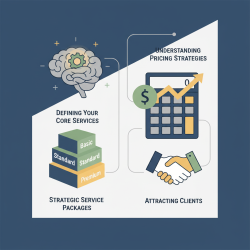
Scaling Your Freelance Bookkeeping Business
- -->> 9. Scaling Your Freelance Bookkeeping Business
What you'll learn
 Business Growth StrategiesTeam Building & DelegationService DiversificationOperational Efficiency
Embarking on a freelance bookkeeping journey often starts with a single client and a passion for financial organization. However, the true test of entrepreneurial spirit lies in moving beyond solo operations to build a thriving, scalable enterprise. Scaling your freelance bookkeeping business involves more than just acquiring more clients; it demands strategic planning, process optimization, and a willingness to delegate. This article explores actionable strategies for expanding your client base, judiciously hiring help, and diversifying your service offerings to ensure long-term success and profitability.
Setting the Foundation for Growth
Before you can successfully scale, your business needs a robust foundation. This involves clearly defining your service scope and operational efficiencies.
Define Your Niche: While it might seem counterintuitive to narrow your focus, specializing in a particular industry (e.g., e-commerce, real estate, non-profits) allows you to develop deep expertise. This expertise makes you more attractive to specific clients and streamlines your marketing efforts, positioning you as an authority rather than a generalist. A well-defined niche enables you to understand common industry challenges and provide tailored solutions.
Standardize Processes: Documenting your workflow for common tasks is crucial. Create templates for client onboarding, monthly reconciliations, payroll processing, and financial reporting. Standardized processes ensure consistency, reduce errors, and are essential for efficient delegation when you bring on staff. They also free up your valuable time for higher-level strategic work.
Leverage Technology: Automation is your best friend when scaling. Utilize cloud-based accounting software, receipt management apps, and secure communication platforms. Integrating these tools can significantly reduce manual data entry, improve accuracy, and provide real-time financial insights for your clients. Consider project management tools to keep track of client deadlines and team tasks.
Strategic Client Acquisition
Growth depends on a steady stream of new clients. Moving beyond word-of-mouth requires a proactive approach.
Cultivate Referral Networks: Build strong relationships with other professionals such as CPAs, financial advisors, and business consultants. They often encounter clients who need bookkeeping services and can be an excellent source of qualified leads. Offer reciprocal referrals where appropriate to foster mutually beneficial partnerships.
Build a Professional Online Presence: A polished website showcasing your expertise, services, and client testimonials is non-negotiable. Leverage professional social media platforms like LinkedIn to share insights and connect with potential clients. Effective online presence involves several key elements:
- A professional, mobile-responsive website.
- Active engagement on relevant social media platforms (e.g., LinkedIn).
- Content marketing through blog posts or articles to establish thought leadership.
- Collecting and displaying client testimonials and case studies.
These efforts establish credibility and attract organic traffic, positioning you as a knowledgeable and trustworthy expert in your field.
Implement Value-Based Pricing: Move away from hourly billing. Instead, offer fixed-fee packages that clearly outline the services included and the value provided. This approach allows clients to budget effectively and rewards you for efficiency, rather than penalizing you for working quickly. Structure your packages to cater to different client needs and complexities.
When and How to Hire Help
The biggest bottleneck to scaling is often yourself. Recognizing when to delegate is a critical step.
Recognize the Need: Signs you need to hire include consistently long work hours, declining client service quality, missed deadlines, or turning away new business. If you're spending too much time on administrative tasks instead of high-value work, it's time to consider assistance.
Define Roles Clearly: Start by identifying tasks that can be easily delegated. This might be a virtual assistant for scheduling and communication, or a junior bookkeeper for data entry and reconciliations. Clearly outline the responsibilities and required skills for each role before you begin your search.
Recruitment and Onboarding: Look for individuals who are not only skilled but also align with your business values. Utilize professional platforms for recruitment. A structured onboarding process ensures new hires understand their roles, access necessary tools, and integrate smoothly into your existing processes and client management systems.
Training and Delegation Best Practices:
- Provide comprehensive training on your standardized processes and software.
- Start with delegating simple, repetitive tasks and gradually increase responsibility.
- Maintain clear communication channels for questions and progress updates.
- Offer constructive feedback and opportunities for professional growth.
Expanding Service Offerings
Once your core operations are running smoothly, consider diversifying your services to increase revenue per client and attract a broader clientele.
Advanced Reporting and Analysis: Go beyond basic financial statements. Offer custom reports, cash flow projections, budget vs. actual analysis, and key performance indicator (KPI) tracking. These services provide deeper insights and become indispensable for strategic business decisions.
Consulting and Advisory Services: Leverage your financial expertise to provide higher-value consulting. This could include business plan development, financial forecasting, strategic planning assistance, or internal control reviews. Position yourself as a trusted financial advisor.
Software Implementation and Training: Many small businesses struggle with setting up and optimizing their accounting software. Offer services to implement new systems, migrate data, and train client staff on best practices. This adds significant value and builds strong client relationships.
Payroll and Sales Tax Management: These specialized areas are often outsourced by small businesses. Developing expertise in payroll processing, sales tax filing, and related compliance can open up new revenue streams and make your service offering more comprehensive.
Maintaining Quality and Client Relationships
Growth should never come at the expense of quality or client satisfaction.
Regular Communication: Establish a routine for checking in with clients. Proactive communication about financial performance, potential issues, or new opportunities builds trust and strengthens relationships. Be accessible and responsive to their needs.
Implement Feedback Mechanisms: Regularly solicit feedback from your clients. This can be through surveys, informal check-ins, or scheduled reviews. Use this feedback to continuously improve your services and identify areas for enhancement. Client testimonials are also powerful marketing tools.
Continuous Professional Development: The financial landscape is constantly evolving. Stay updated on new tax laws, accounting software updates, and industry best practices. This commitment to learning ensures you can always offer the most relevant and valuable services to your clients.
Summary
Scaling a freelance bookkeeping business is an exciting yet challenging endeavor that requires a strategic approach. It begins with establishing a strong foundation through niche definition, process standardization, and technology adoption. Effective client acquisition strategies, including networking and a strong online presence, are vital for growth. Crucially, knowing when and how to hire and delegate tasks allows you to expand capacity and focus on higher-value activities. Diversifying your service offerings beyond basic bookkeeping, such as providing advisory services or software implementation, significantly enhances your revenue potential and client value. Throughout this growth, maintaining high-quality service and nurturing strong client relationships remain paramount for sustained success.
Comprehension questions
 Why is defining a niche important for scaling a freelance bookkeeping business?What are some key technological tools recommended for leveraging automation in a scaling bookkeeping business?Besides word-of-mouth, what are two proactive strategies for acquiring new clients mentioned in the article?List two ways a freelance bookkeeper can expand their service offerings beyond basic bookkeeping.
Community Poll
Next Lesson

Course Contents : Running a Freelance Bookkeeping Business
- >> 9.
 Scaling Your Freelance Bookkeeping Business