Legal and Operational Foundations
- -->> 1. Legal and Operational Foundations
What you'll learn
 Choosing Legal StructureRegulatory ComplianceOperational FoundationsProfessional Guidance
Embarking on the journey of launching a cosmetics service business requires more than just a passion for beauty; it demands a robust understanding of the legal and operational foundations that will support your venture. Selecting the correct business structure is a critical initial step, influencing everything from liability and taxation to administrative complexity and future growth potential. This article will guide you through the essential considerations, helping you build a resilient framework for your beauty enterprise.
Choosing Your Legal Structure: The Foundation of Your Business
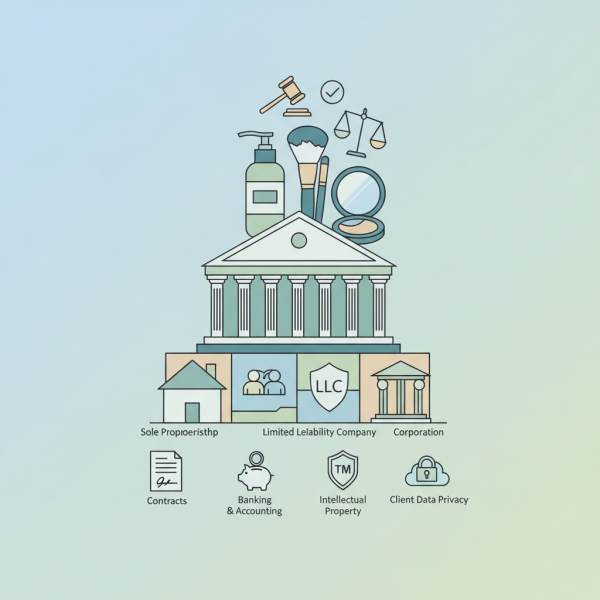
The legal structure you choose for your cosmetics service business dictates how it is perceived by law and how it operates financially. Each option comes with distinct advantages and disadvantages concerning personal liability, taxation, and management.
Sole Proprietorship
This is the simplest and most common structure for solo entrepreneurs. You, as the individual, are indistinguishable from your business in the eyes of the law. It's easy to set up with minimal paperwork.
- Pros: Full control, easy setup, "pass-through" taxation (profits and losses reported on personal income tax).
- Cons: Unlimited personal liability (your personal assets are at risk for business debts and lawsuits), difficulty raising capital.
Partnership
If you're starting with one or more partners, a partnership might be suitable. This structure involves two or more people who agree to share in the profits or losses of a business.
- Pros: Shared workload and capital, relatively easy to set up with a partnership agreement.
- Cons: Partners share unlimited personal liability (unless a Limited Partnership or Limited Liability Partnership is formed), potential for disputes, "pass-through" taxation.
Limited Liability Company (LLC)
An LLC offers a hybrid structure, combining the limited liability protection of a corporation with the pass-through taxation and operational flexibility of a partnership or sole proprietorship. This is often a popular choice for small business owners.
- Pros: Personal asset protection (limited liability), flexible taxation options (can be taxed as a sole proprietorship, partnership, S-corp, or C-corp), less formal than a corporation.
- Cons: More complex to set up than a sole proprietorship or partnership, some states impose additional fees.
Corporation (C-Corp or S-Corp)
Corporations are separate legal entities from their owners. They offer the strongest liability protection but come with significant administrative burdens. C-Corps are subject to "double taxation," while S-Corps avoid this by passing profits and losses directly to the owners' personal income without being subject to corporate tax rates.
- Pros: Excellent personal liability protection, easier to raise capital by selling stock, perpetual existence.
- Cons: Most complex and expensive to set up and maintain, extensive record-keeping, strict compliance requirements.
Essential Registrations and Regulatory Compliance
Once your legal structure is chosen, the next crucial step involves navigating the world of registrations, licenses, and permits. This ensures your cosmetics service business operates legally and ethically within your jurisdiction.
Business Name Registration and EIN
Your business name must be registered, typically with your state's Secretary of State or a similar agency. If you plan to hire employees or operate as a corporation or LLC, you will need an Employer Identification Number (EIN) from the IRS, which functions as your business's Social Security number.
State and Local Licenses and Permits
Cosmetics services often fall under specific regulations. You'll likely need a general business license from your city or county. Depending on your services (e.g., esthetics, cosmetology, makeup artistry with chemical applications), professional licenses for you and any employees are mandatory. Check with your state's board of cosmetology or equivalent regulatory body.
Health and Safety Regulations
Operating a beauty service means adhering to strict health and safety protocols. This includes sanitation standards for tools and equipment, proper storage of products, ventilation, and waste disposal. Compliance is paramount for client safety and avoiding legal repercussions.
Business Insurance
Protecting your business from unforeseen circumstances is vital. Consider general liability insurance to cover slips, falls, or property damage, and professional liability (malpractice) insurance for claims arising from your services. Property insurance for your salon space and workers' compensation if you have employees are also critical.
Establishing Robust Operational Foundations
Beyond legal compliance, strong operational foundations ensure the smooth and efficient running of your cosmetics service business day-to-day.
Dedicated Business Banking and Accounting
Separate your personal and business finances immediately. Open a dedicated business bank account and implement a robust accounting system. This simplifies tax preparation, provides a clear financial picture, and reinforces your chosen legal structure's liability protection.
Contracts and Agreements
Formalize relationships with clients, suppliers, and potential employees through clear, written contracts. Client agreements can outline services, pricing, cancellation policies, and waivers. Supplier contracts ensure fair terms for product acquisition. Employee contracts cover roles, responsibilities, compensation, and confidentiality.
Intellectual Property
Your brand identity is a valuable asset. Consider trademarking your business name, logo, and unique service names. If you develop proprietary cosmetic formulas or techniques, explore patent or trade secret protections to safeguard your innovations.
Client Data Privacy and Security
Handling client information, including contact details, service history, and payment information, requires a commitment to privacy. Implement secure systems for data storage and adhere to privacy regulations like GDPR or CCPA if applicable, ensuring trust and compliance.
Seeking Professional Guidance
Navigating the intricacies of business structures, legal compliance, and operational best practices can be complex. Engaging with legal counsel and financial advisors early in the process is highly recommended. These professionals can offer tailored advice, ensuring you make informed decisions that protect your business and foster its growth.
Summary
Establishing a cosmetics service business on a solid legal and operational foundation is fundamental to its success and longevity. This article has explored the various legal structures, including sole proprietorships, partnerships, LLCs, and corporations, highlighting their respective implications for liability and taxation. We also delved into essential registrations such as business name registration and EINs, alongside critical regulatory compliance requirements like state and local licensing, health and safety standards, and business insurance. Furthermore, we covered robust operational foundations, including dedicated business banking, the necessity of clear contracts, the protection of intellectual property, and client data privacy. By meticulously addressing these foundational elements, entrepreneurs can build a resilient, compliant, and thriving cosmetics service enterprise.
Comprehension questions
 What are the key differences in liability and taxation between a Sole Proprietorship and an LLC for a cosmetics service business?Why is an Employer Identification Number (EIN) necessary for certain business structures, and what is its purpose?Besides general business licenses, what specific types of licenses or regulations might a cosmetics service business need to adhere to?What are some essential operational foundations that ensure the smooth and efficient day-to-day running of a cosmetics service business?
Review Quiz
Next Lesson

Course Contents : Strategies for Small Cosmetic Businesses
- >> 1.
 Legal and Operational Foundations