Production, Quality, and Workflow Integration
- -->> 4. Production, Quality, and Workflow Integration
What you'll learn
 Production TechniquesQuality Control MethodsWorkflow Optimization StrategiesOperational Integration
This lesson delves into three foundational pillars that underpin successful operations: advanced production techniques, stringent quality control measures, and intelligent workflow optimization. Mastering these areas is not merely about achieving operational competence; it is about establishing a sustainable competitive advantage, fostering innovation, and consistently delivering value to customers. Understanding their interplay allows organizations to refine processes, minimize waste, and produce high-quality outputs with greater predictability and speed.
Understanding Production Techniques
Production techniques refer to the systematic methods and processes employed to transform raw materials or inputs into finished products or services. The choice of technique significantly impacts cost, quality, flexibility, and delivery speed. Modern businesses often adopt various methodologies to suit their specific needs and market demands.
Key production techniques include:
- Lean Manufacturing: Focuses on minimizing waste within manufacturing systems while maximizing productivity. It aims to eliminate non-value-adding activities, such as overproduction, waiting, unnecessary transport, over-processing, excess inventory, unnecessary motion, and defects.
- Agile Methodologies: Predominantly used in software development, Agile emphasizes iterative development, flexibility, customer collaboration, and rapid response to change. It breaks down projects into smaller, manageable sprints, allowing for continuous feedback and adaptation.
- Just-In-Time (JIT) Production: A strategy that aims to reduce inventory costs and waste by receiving goods only as they are needed for production, rather than storing large inventories. This requires highly coordinated supply chains and efficient forecasting.
- Automation and Robotics: Involves the use of technology to perform tasks with minimal human intervention. This can increase speed, precision, consistency, and safety, particularly in repetitive or hazardous operations.
Selecting the appropriate technique involves a thorough analysis of product characteristics, production volume, technological capabilities, and market requirements. Often, a hybrid approach combining elements from different techniques yields the best results.
The Crucial Role of Quality Control
Quality control (QC) is a process by which entities review the quality of all factors involved in production. ISO 9000 defines quality control as "a part of quality management focused on fulfilling quality requirements." Its primary objective is to ensure that products or services consistently meet specified standards and customer expectations.
Effective quality control involves several key activities:
- Setting Standards: Defining clear, measurable quality criteria for products, processes, and services.
- Inspection and Testing: Regularly checking products at various stages of production to identify and rectify defects. This can include raw material inspection, in-process checks, and final product testing.
- Statistical Process Control (SPC): Using statistical methods to monitor and control a process to ensure it operates at its full potential. SPC helps in identifying variations and preventing defects proactively.
- Feedback Loops: Establishing mechanisms to gather feedback from customers and internal stakeholders to drive continuous improvement in quality.
- Documentation: Maintaining detailed records of quality checks, defects found, and corrective actions taken.
Robust quality control leads to fewer defects, reduced rework, enhanced customer satisfaction, stronger brand reputation, and significant cost savings over time by preventing costly recalls or customer service issues.
Workflow Optimization for Efficiency
Workflow optimization is the systematic process of improving the efficiency, effectiveness, and adaptability of an organization's work processes. It involves analyzing existing workflows, identifying bottlenecks, eliminating unnecessary steps, and streamlining operations to achieve specific goals, such as increased productivity, reduced costs, or faster delivery times.
The optimization process typically includes these steps:
- Workflow Mapping: Documenting the current state of a workflow from start to finish, identifying all tasks, roles, dependencies, and decision points. This visual representation helps in understanding the process flow.
- Bottleneck Identification: Pinpointing areas where work slows down, accumulates, or causes delays. Bottlenecks can be due to resource constraints, inefficient handoffs, or complex approval processes.
- Process Streamlining: Implementing changes to remove bottlenecks and redundancies. This might involve automating repetitive tasks, redesigning forms, reallocating resources, or simplifying decision-making hierarchies.
- Technology Integration: Utilizing project management software, enterprise resource planning (ERP) systems, or specialized automation tools to manage tasks, track progress, and facilitate communication, thereby enhancing workflow visibility and control.
- Continuous Monitoring and Improvement: Regularly reviewing optimized workflows to ensure they remain effective and adapting them as organizational needs or external conditions change.
Successful workflow optimization results in higher productivity, lower operational costs, improved resource utilization, faster time-to-market for products or services, and a more engaged workforce due to clearer processes and reduced frustrations.
Integrating Production, Quality, and Workflow
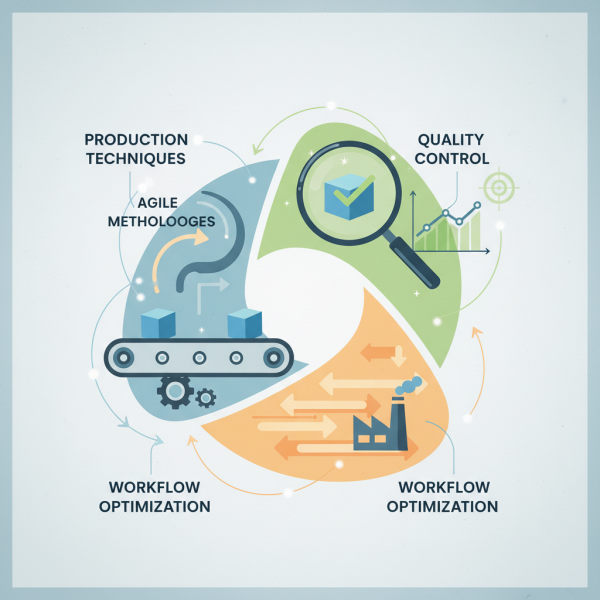
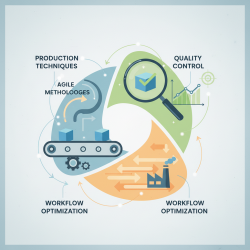
While each of these areas—production techniques, quality control, and workflow optimization—is critical on its own, their true power is unleashed when they are integrated into a cohesive operational strategy. An efficient production technique, such as Lean, inherently seeks to optimize workflow by eliminating waste. Robust quality control measures are most effective when embedded directly into optimized workflows, rather than being a standalone inspection at the end. Conversely, optimized workflows provide the structure and clarity necessary for production techniques to be implemented effectively and for quality control checks to be consistently applied.
This integration creates a synergistic effect, driving continuous improvement across the entire value chain. Organizations that successfully harmonize these three pillars are better positioned to respond to market changes, innovate, maintain high product standards, and ultimately achieve sustained growth and profitability.
Summary
This article explored the fundamental concepts of production techniques, quality control, and workflow optimization, highlighting their individual significance and collective power. We discussed various production methods like Lean and Agile, the importance of quality control in meeting standards and customer expectations through methods like SPC, and the strategic process of workflow optimization to enhance efficiency and productivity. The overarching theme emphasized that integrating these three operational pillars is crucial for any organization aiming to achieve sustained excellence, minimize waste, and deliver superior products or services efficiently and consistently.
Comprehension questions
 What are the primary objectives of Lean Manufacturing, and how does it differ from Just-In-Time (JIT) production?Describe at least three key activities involved in effective quality control and explain why Statistical Process Control (SPC) is considered a proactive measure.Outline the typical steps involved in the workflow optimization process, from initial analysis to continuous improvement.Explain the synergistic effect achieved when production techniques, quality control, and workflow optimization are integrated, rather than treated as separate operational areas.
Community Poll
Next Lesson

Course Contents : Building Your Custom Jewelry Business
- >> 4.
 Production, Quality, and Workflow Integration