Essential Tools and Strategic Sourcing for Jewelry Making
- -->> 2. Essential Tools and Strategic Sourcing for Jewelry Making
What you'll learn
 Basic Jewelry Hand ToolsAdvanced Jewelry Making EquipmentEssential Jewelry MaterialsStrategic Material Sourcing
Before you can transform raw materials into wearable art, it's crucial to understand the foundational elements: the essential tools that will shape your vision and the quality materials that will bring it to life. This lesson serves as your comprehensive guide to equipping your workspace effectively and mastering the art of sourcing, ensuring that every piece you create is a testament to craftsmanship and quality from start to finish.
Fundamental Hand Tools for Jewelry Making
The foundation of any successful jewelry studio lies in a well-curated collection of hand tools. These are the instruments you'll reach for constantly, and investing in good quality will pay dividends in ease of use and the longevity of your tools.
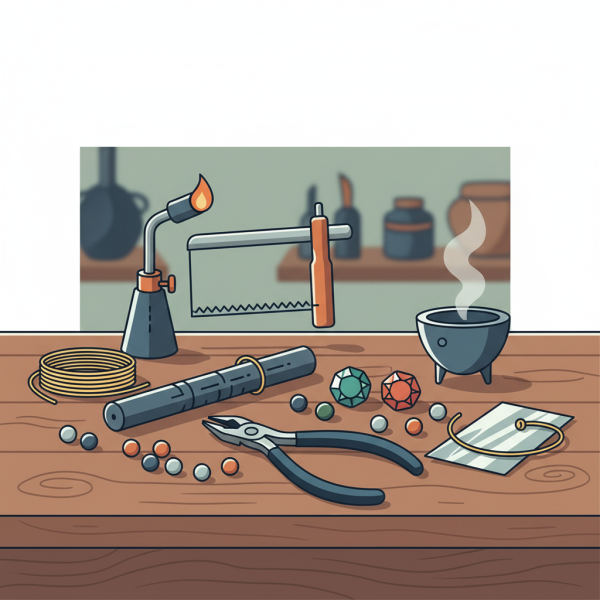
- Pliers: A diverse set is indispensable. Round-nose pliers are perfect for creating loops and curves, while chain-nose pliers offer precision for gripping, bending, and opening jump rings. Flat-nose pliers provide a broader grip for straightening wire, and bent-nose pliers allow access to tight spaces. Nylon-jaw pliers are also valuable for straightening wire without marring its surface.
- Cutters: Flush cutters provide a clean, flat cut on wire, essential for professional finishes. Side cutters are robust for heavier gauge wire and general cutting tasks.
- Files: A set of needle files, in various shapes like round, half-round, and flat, allows for precise shaping and smoothing of metal edges. A larger half-round file is useful for general shaping.
- Hammers: A rawhide or nylon hammer is used for shaping metal without marring it, while a chasing hammer can be used for texturing or riveting. A small bench hammer is also useful for general tasks.
- Mandrels: Ring mandrels are tapered steel forms used for shaping, sizing, and hardening rings. Bracelet mandrels serve a similar purpose for bangles and cuffs.
- Bench Pin: This wooden or plastic attachment clamps to your workbench, providing a stable support for sawing, filing, and other tasks.
- Ruler and Calipers: Accurate measurements are critical. A steel ruler and digital calipers ensure precision in all your designs.
These basic tools will form the backbone of your jewelry making capabilities, allowing you to manipulate and shape various materials with confidence.
Specialized Tools for Advanced Techniques
As your skills evolve, you may want to explore more intricate techniques that require specialized equipment. These tools open up new possibilities for design and complexity.
- Soldering Setup: This includes a jewelers' torch, various types of solder (easy, medium, hard), flux, a soldering block, and a pickle pot with pickle solution for cleaning fire scale off soldered metal. Soldering allows for permanent joins and the creation of more complex metal structures.
- Flex Shaft or Rotary Tool: A versatile motorized tool with various attachments, a flex shaft can be used for drilling, grinding, sanding, polishing, and even carving. It significantly speeds up many processes.
- Polishing Equipment: A small bench polisher with various buffing wheels and polishing compounds will give your finished pieces a professional, high-luster shine.
- Metal Stamps: For personalizing pieces, metal stamps allow you to emboss letters, numbers, and decorative symbols onto metal surfaces.
- Jeweler's Saw: This fine-bladed saw is essential for cutting intricate shapes out of sheet metal, allowing for detailed silhouettes and openwork designs.
These specialized tools, while a larger investment, can significantly expand your creative repertoire and the professional finish of your custom jewelry.
Essential Materials for Custom Jewelry
The beauty of custom jewelry lies in the choice of materials. Understanding the characteristics of different metals, stones, and findings is crucial for creating durable and attractive pieces.
- Metals: Sterling silver is a popular choice due to its workability and luster. Gold-filled wire and sheet offer the look of gold at a more accessible price point. Copper, brass, and bronze are excellent for practice and offer unique color palettes. Artisan wire, available in various metals and gauges, is fundamental for wire wrapping and forming.
- Gemstones: These can be purchased as cabochons (smooth, polished, often domed stones), faceted stones (cut with multiple faces to maximize sparkle), or as beads. Consider their hardness, durability, and how they will be incorporated into your design.
- Beads: A vast array of beads exists, including glass, wood, seed beads, and shell beads. They add color, texture, and interest to many jewelry designs.
- Findings: These are the components that finish and connect your jewelry. Essential findings include clasps (toggle, lobster, hook-and-eye), jump rings (for connecting components), headpins and eyepins (for creating dangles and links), and ear wires (for earrings).
- Adhesives: Specialized jewelry glues are necessary for securely setting stones or attaching components that cannot be soldered.
Selecting high-quality materials ensures the longevity and beauty of your finished custom jewelry pieces.
Sourcing Strategies for Quality Materials
Finding reliable suppliers for tools and materials is as important as knowing how to use them. Strategic sourcing ensures you get the best quality for your budget.
Local Bead and Hobby Stores: These are great starting points for basic tools, a wide variety of beads, and some findings. They allow you to see and feel the products before purchasing.
Online Specialty Suppliers: Websites dedicated to jewelry making supplies offer a vast selection of tools, metals, and gemstones, often at competitive prices. Research different suppliers and read reviews to ensure their reputation for quality and customer service. Many offer wholesale pricing for bulk purchases.
Gem and Jewelry Shows: Attending local or national gem and jewelry shows is an excellent way to source unique gemstones, beads, and sometimes tools directly from vendors. You can often find better prices and a wider selection than online or in local stores.
Ethical Sourcing: When purchasing gemstones and precious metals, consider the ethical implications. Look for suppliers who can verify the origin of their materials, ensuring they are responsibly mined and traded.
Bulk Purchasing: Once you know which materials you use frequently, consider buying in bulk from wholesale suppliers. This can significantly reduce your per-unit cost over time.
Always verify the authenticity and quality of your materials, especially precious metals and gemstones, to maintain the integrity of your custom jewelry.
Summary
This lesson has provided a comprehensive overview of the essential tools and materials required for custom jewelry making, from fundamental hand tools like pliers and cutters to specialized equipment such as soldering setups and flex shafts. We also explored the diverse range of materials, including various metals, gemstones, and findings, critical for bringing designs to life. Furthermore, we delved into effective sourcing strategies, emphasizing the importance of quality, ethical considerations, and finding reliable suppliers to ensure the success and professionalism of your jewelry creations.
Comprehension questions
 What are the four primary types of pliers considered fundamental for custom jewelry making?Name three specialized tools that can elevate jewelry crafting beyond basic techniques.What are some of the key metal options available for custom jewelry, and why is material quality important?What are two effective strategies for sourcing high-quality materials for custom jewelry projects?
Review Quiz
Next Lesson
Course Contents : Building Your Custom Jewelry Business
- >> 2.
 Essential Tools and Strategic Sourcing for Jewelry Making